The bench press is one of the most famous muscle-building exercises in the gym. For men over 50, it can also be one of the most misunderstood.
Most lifters think the only “real” bench press is the full-range version: lower the bar all the way to the chest, press it to lockout, repeat until tired. That may be fine for some younger lifters with perfect shoulders, perfect recovery, and no history of joint irritation. But if you are over 50 and still serious about building muscle, the better question is not, “How low can I lower the bar?”
The better question is: Where can I train the target muscles with the greatest intensity and the least unnecessary joint stress?
That is where the Power Factor Workout approach changes everything.
Why the Bench Press Still Matters After 40
The bench press strengthens several of the most important upper-body muscles: the pectorals, front deltoids, triceps, and the stabilizing muscles of the upper back and torso. Stronger pressing muscles help with real-life strength, better posture, improved confidence, and the ability to keep performing physical work without feeling fragile.
But the standard full-range bench press often loads the shoulders heavily in the bottom position. That deep stretch may feel traditional, but tradition is not the same as intelligence. Many experienced lifters know exactly what happens when the shoulder joint is forced into a vulnerable range under heavy weight: pain, hesitation, and eventually missed workouts.
The Power Factor solution is simple. Perform the bench press in your strongest, safest range.
The Power Factor Bench Press
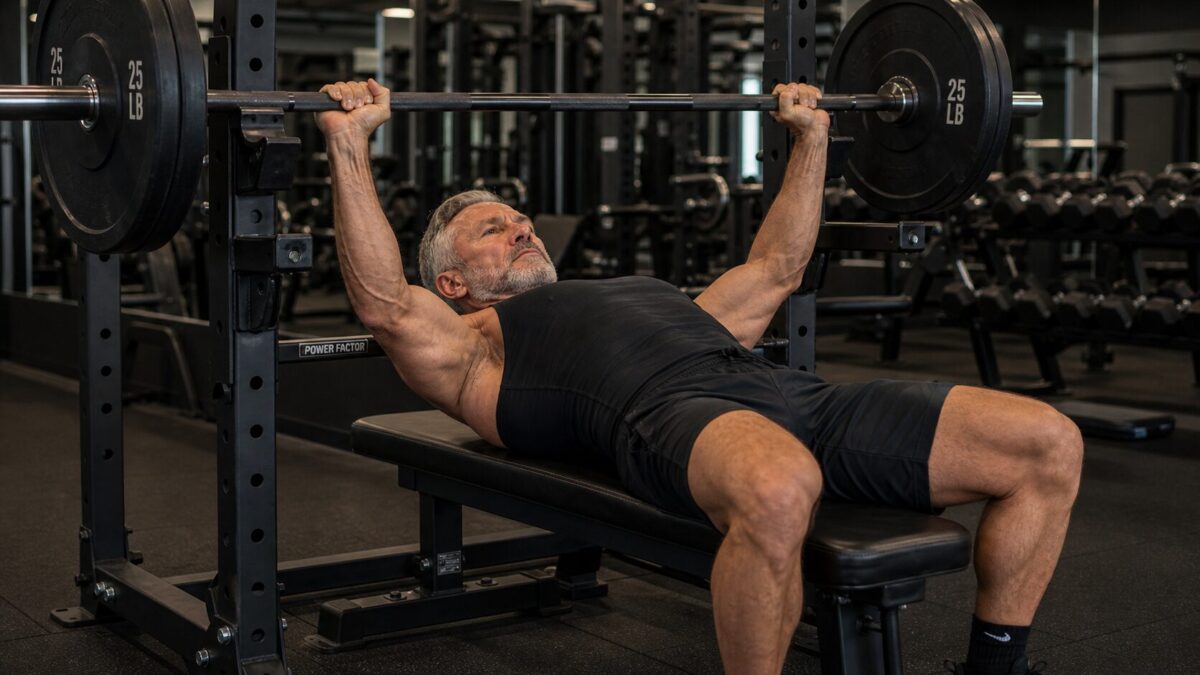
In a Power Factor bench press, you do not need to lower the bar all the way to your chest. Instead, you use a power rack or Smith machine with safety stops set so the bar moves only through the stronger top portion of the movement.
This stronger range allows you to handle a challenging weight with better control. You are not trying to impress anyone with an exaggerated stretch. You are trying to generate measurable muscular output.
That is the key difference.
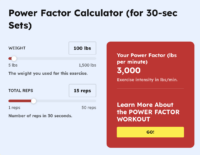
Most workouts are based on vague effort: “I trained hard,” “I got a pump,” or “I was tired when I left.” The Power Factor method replaces guesswork with numbers. You record the weight, the number of reps, and the exact time. Then you calculate your intensity.
Weight × Reps × 2 = Pounds Per Minute
If you bench 200 pounds for 15 controlled reps in 30 seconds, your Power Factor number is:
200 × 15 × 2 = 6,000 pounds per minute
Now you know exactly what you did. Next time, your job is to beat that number.
Why This Helps Reduce Over-Training
Men over 50 do not usually fail because they lack effort. They fail because they use too much effort in the wrong places, too often, without enough recovery.
A properly performed 30-second Power Factor set is brutally focused. You are asking the muscles to produce serious output in a short period of time. That means you do not need marathon workouts filled with set after set of joint-grinding volume.
You perform the exercise. You measure it. You recover. Then you come back only when you are ready to improve.
That last point matters. If your numbers are not going up, your body may be telling you that it has not finished adapting. More exercise is not always the answer. Better measurement is.
Practical Tips for the Power Factor Bench Press
Set the safety pins so the bar stops before your shoulders enter a painful or vulnerable position. Keep your shoulder blades pulled back and down. Keep your feet planted. Use a controlled tempo. Do not bounce the bar off the pins. Do not turn the set into a sloppy race.
Your goal is to perform as many strong, controlled reps as possible in exactly 30 seconds. When the time is up, stop. Record the weight and reps immediately.
On your next bench press workout, look at your previous number and aim for a small improvement. Add a little weight, add a rep, or both. The improvement does not have to be dramatic. It has to be measurable.
The Bottom Line
The bench press can still be a powerful muscle-building exercise after 50. But it should be performed intelligently. You do not need to punish your shoulders to build your chest. You need to train the right muscles, in the right range, with measurable intensity and enough recovery to grow stronger.
That is the Power Factor difference.
If you want to build muscle after 40 or 50 without wasting time, aggravating old injuries, or guessing whether your workout worked, start tracking your numbers. Use the strongest, safest range. Train hard for a short period. Recover fully. Then come back and beat your previous performance.
To learn more about smarter strength training for men over 40, visit PowerFactorWorkout.com and discover how the Power Factor Workout helps you build measurable strength without needless wear and tear.