The Deadlift After 40: Build Serious Strength in the Safest Range
Few exercises have a better reputation for building real-world strength than the deadlift.
Done conventionally, it trains the muscles that help you stand tall, brace your torso, pull, lift, and move with power. The glutes, hamstrings, spinal erectors, upper back, traps, lats, forearms, and gripping muscles all get called into action. That is why the deadlift has earned its place as one of the great strength-building movements.
But for men over 40, there is an important question that rarely gets asked:
Do you need to pull from the floor to get the muscle-building benefits?
In the Power Factor Workout, the answer is simple: not necessarily.
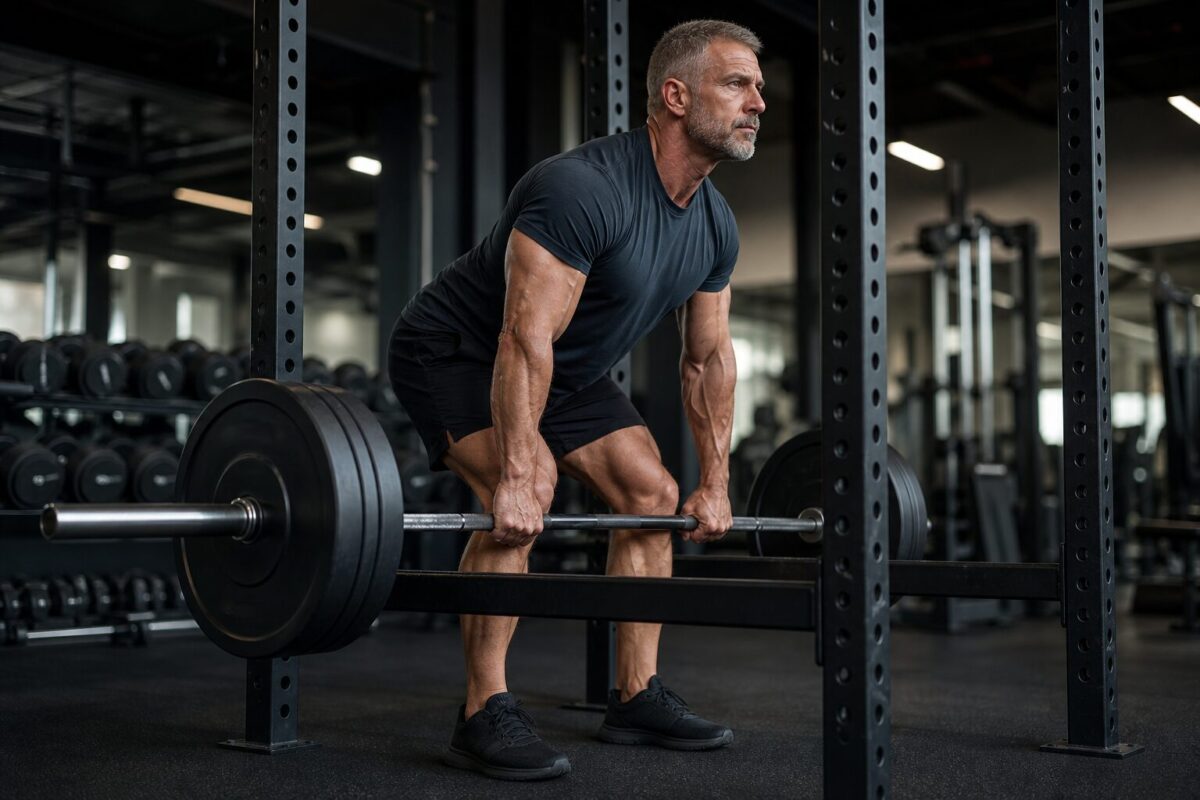
The goal is not to imitate a powerlifting contest. The goal is to generate productive muscular intensity in a way that can be measured, repeated, improved, and recovered from. That is why the deadlift performed inside a power rack, with the safety pins set around knee level, can be such a valuable exercise for older lifters who still want serious strength without needless wear and tear.
Why the Rack Deadlift Makes Sense After 40
A conventional deadlift starts from the floor. For many lifters, that lowest position is also the most mechanically awkward and vulnerable part of the lift. Your hips are low, your back angle is more demanding, your knees and hips are under more strain, and your form has to be nearly perfect before the bar even moves.
Now ask yourself this: if the weakest range forces you to use less weight, is your strongest range ever being challenged properly?
That is the heart of the Power Factor idea.
When you set the bar on safety pins at approximately knee height, you remove much of the weakest and riskiest bottom portion of the exercise. Now you are training the stronger range of the pull. You can handle more weight, concentrate on controlled effort, and overload the big muscles of the posterior chain more directly.
This is not “cheating.” It is choosing the range that delivers the most productive work for the purpose at hand.
The Muscles You Strengthen
A properly performed rack deadlift can powerfully train the muscles many older men most need to keep strong:
Glutes and hamstrings help drive hip extension and support athletic movement, climbing, lifting, and standing from seated positions.
Spinal erectors and core bracing muscles help maintain posture and torso stability under load.
Traps, lats, and upper back are heavily involved in holding the bar close and keeping the shoulders locked into a safe, powerful position.
Forearms and grip are challenged intensely, especially as the weight rises.
This is a lot of muscle for one exercise. That is why the deadlift, used intelligently, deserves attention from any man who wants to build muscle after 40 and stay strong for life.
How to Perform the Power Factor Rack Deadlift
Start with a power rack and set the safety pins so the bar rests around knee level. Use a height that lets you maintain a strong neutral spine and a controlled hip hinge. Do not use a position that causes pain or forces you into sloppy mechanics.
Warm up thoroughly. Do several lighter sets until the movement feels smooth and your joints, tendons, and muscles are ready for heavier work.
When the work set begins, use a load you can move through a short, controlled range for exactly 30 seconds. Do not yank the bar. Do not bounce the plates against the pins. Do not turn it into a circus act. Pull smoothly, lower under control, and keep the tension where it belongs.
At the end of the set, record the weight and the number of reps completed in 30 seconds.
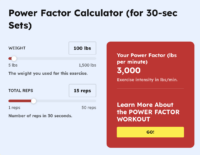
Then calculate your Power Factor number:
Weight × Reps × 2 = Pounds per Minute
For example, if you use 300 pounds for 12 controlled reps in 30 seconds, your number is:
300 × 12 × 2 = 7,200 lbs/min
That number matters because it gives you something most gym workouts never provide: objective feedback.
Do Not Repeat the Same Workout Twice
The purpose of training is adaptation. If your body can already handle a certain level of output, repeating that exact same output gives it no new reason to grow stronger.
So the next time you perform the rack deadlift, your goal is simple: beat your previous number. Add a little weight, add one or two reps, or improve the total output in the same 30-second window.
But do not rush back before you are recovered. That is a mistake many men make. They think more workouts automatically mean more progress. They do not. If your numbers are not improving, you may be training too soon.
After 40, recovery is not a minor detail. It is part of the system.
Practical Safety Tips
Use a power rack with properly set pins. Keep the bar close to your legs. Brace before every rep. Keep your spine neutral. Use lifting straps or hooks if your grip is limiting your back and hip strength. Stop immediately if you feel pain, strain, dizziness, or anything unusual.
And remember: the goal is not to impress the guy across the gym. The goal is to build measurable strength with the least wasted motion and the least unnecessary punishment.
The Bottom Line
The deadlift can be one of the most productive strength exercises you ever perform. But after 50, the smartest version may not be the longest range. It may be the strongest, safest range inside a power rack.
That is where you can challenge the muscles that matter, measure your output, protect your recovery, and keep progressing without turning your workouts into joint-grinding marathons.
If you want to build muscle after 40 or 50, stop guessing. Use the Power Factor approach. Train in a range that lets you generate real output. Track your numbers. Recover fully. Then come back stronger.
Train with your brain.
To learn more, look at this PowerFactorWorkout.com and see how the POWER FACTOR WORKOUT helps men over 40 build strength with smarter, measured training.