There comes a point in a man’s training life when he starts asking better questions.
In his twenties, the question may have been, “How much can I lift?” In his thirties, it may have been, “How often can I train?” But after 40, the wiser question becomes: “How can I keep building muscle without grinding down my joints, wasting recovery, or spending half my life in the gym?”
That is exactly where the Power Factor Workout becomes so useful.
The goal is not to prove how much punishment you can survive. The goal is to create a powerful muscle-building stimulus, measure it honestly, and recover well enough to improve the next time. That is how experienced lifters keep progressing when the old high-volume routines start taking more than they give back.
The Problem With Training Like You’re Still 25
Many men over 40 still approach weight training as if more sets, more reps, more exercises, and more gym time must automatically produce more muscle. But the body does not work that way forever.
At some point, excess training becomes a recovery problem. Your muscles may still be willing, but your elbows, shoulders, knees, hips, and lower back start sending messages you should not ignore.
That does not mean you are finished. It means your training has to become more intelligent.
Power Factor training is built around a simple idea: if you can measure your output, you can manage your progress. Instead of guessing whether a workout was “good,” you record the weight, the repetitions, and the time. That gives you an objective number to beat in the future.
Train Where You Are Strongest and Safest
One of the most practical lessons for older weightlifters is this: you do not have to use the weakest, most vulnerable part of a lift to stimulate muscle growth.
Many common exercises place the joints under the most stress when the muscle is in a disadvantaged position. Think of the bottom of a bench press, the deepest part of a squat, or the fully stretched position of many pressing and pulling movements. That is often where form breaks down, connective tissue complains, and injuries begin.
The Power Factor approach emphasizes using the strongest and safest range of motion. That allows many men to use meaningful resistance, generate high muscular output, and reduce unnecessary wear and tear.
This is not about making training easy. In fact, properly performed Power Factor training can be brutally demanding. But it shifts the stress where it belongs: onto the working muscles, not the joints.
The 30-Second Test That Tells the Truth
Here is a simple way to understand the method.
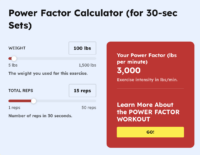
Choose an exercise from your normal gym routine. Use a weight you can control safely. Perform as many strong, controlled reps as possible in 30 seconds, using the prescribed Power Factor range. Then record the weight and reps.
The basic Power Factor calculation is simple:
Weight × Reps × 2 = Pounds Per Minute
Why multiply by two? Because you performed the work for 30 seconds, and doubling it gives you a per-minute output number.
For example, if you used 200 pounds for 15 reps in 30 seconds, your Power Factor would be:
200 × 15 × 2 = 6,000 pounds per minute
Now you have a number. Not a feeling. Not a guess. A number.
The next time you perform that exercise, your goal is to beat that number while keeping the movement controlled and safe.
Why This Matters More After 40
Men over 40 cannot afford to waste recovery ability. Every hard set has a cost. Every unnecessary exercise drains energy that could have been used to grow stronger.
That is why brief, focused, measurable workouts are so valuable. You are not wandering around the gym collecting fatigue. You are testing output, stimulating growth, and then getting out so recovery can do its job.
Muscle is not built during the workout. The workout is the trigger. The building happens afterward, when the body has enough time and resources to adapt.
Practical Tips for Smarter Muscle Building After 40
First, stop chasing soreness. Soreness is not proof of progress. Your numbers are a better guide.
Second, protect your joints by controlling the range. Use the part of the movement where you are strongest and most stable.
Third, write everything down. Record the exercise, weight, reps, time, and Power Factor number.
Fourth, do not repeat the same workout just because it felt good. The goal is progression, not repetition for its own sake.
Fifth, respect recovery. If you are not improving, the answer is not always more training. Often, it is more recovery.
Conclusion: Train Harder, Not Longer
Building muscle after 40 is not about surrendering to age. It is about refusing to train foolishly.
You can still push hard. You can still build strength. You can still improve your physique. But the method matters more than ever.
The Power Factor Workout gives you a way to train with intensity, measure your progress, reduce wasted effort, and avoid the overtraining trap that stops so many older lifters.
If you want to learn how to build muscle with shorter, smarter, more measurable workouts, take a closer look at the POWER FACTOR WORKOUT and see how this system has helped lifters rethink what productive training really means.