Broad shoulders still matter. They matter for strength. They matter for posture. They matter for how a man carries himself when he walks into a room. And they matter for the simple daily tasks that require you to press, brace, lift, reach, and control weight above the torso.
But if you are over 40, the standing barbell shoulder press can become a problem exercise. Not because the movement is useless. Far from it. The shoulder press can strengthen the deltoids, triceps, upper chest, traps, upper back, and the stabilizing muscles through the trunk. It is one of the best tests of real upper-body power.
The problem is that many men keep forcing the exercise through the weakest and most vulnerable portion of the lift. That is where shoulders complain, elbows ache, and old injuries send their little reminder notices.There is a smarter way.
The Power Factor Way to Shoulder Press
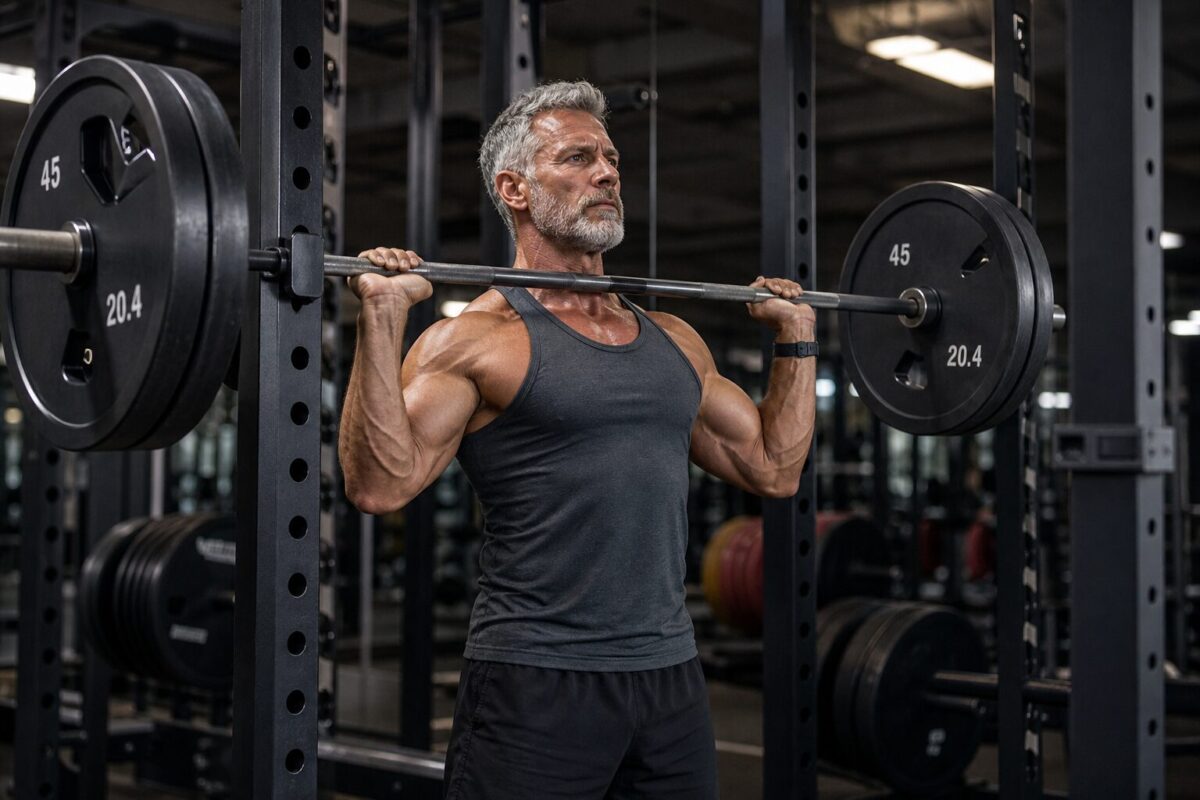
In the Power Factor Workout, the purpose of an exercise is not to satisfy gym tradition. The purpose is to create productive muscular demand that can be measured, improved, and recovered from. That is why the standing barbell shoulder press should be performed inside a power rack.
Set the safety pins so the bar starts in your strongest and safest pressing range. For many men, this will be somewhere around forehead level, eye level, or slightly above, depending on shoulder comfort, arm length, and injury history. The exact height is not chosen by ego. It is chosen by control.
If the bottom half of the shoulder press is where your shoulders grind, your lower back arches, or your form breaks down, why make that weak range the boss of the whole exercise? You are not in the gym to prove loyalty to a full range of motion. You are there to build muscle and strength without unnecessary wear and tear.
Why This Exercise Is Valuable After 40
The standing barbell shoulder press is not just a shoulder exercise. It is a whole-body discipline. Your deltoids press the bar. Your triceps finish the movement. Your traps and upper back help stabilize the shoulder girdle. Your core, hips, glutes, and legs help keep you rooted and upright.
Done correctly, it strengthens the muscles that help a man stay broad, upright, and capable. It can improve pressing power, shoulder stability, upper-body density, and the kind of real-world strength that carries over into life outside the gym.
That matters after 40. Muscle loss is not just a cosmetic problem. Weakness changes how you move, how you stand, and how much confidence you have in your own body. Strong shoulders and a strong upper back help resist that decline.
But the goal is not to beat up your joints in the name of toughness. The goal is to stimulate the muscle while avoiding the range that causes pain.
How to Set It Up in the Power Rack
Place the barbell on the safety pins at a height where you can begin the press strongly and safely. Stand with your feet about shoulder-width apart. Keep your body tight, your glutes braced, and your torso upright. Grip the bar slightly wider than shoulder width. Do not lean back and turn the movement into an awkward incline press. Do not bounce the bar off the pins. Do not slam into lockout. Press the bar through a short, controlled range. Lower it back to the pins under control. Repeat with precision. This is not cheating. Cheating is using momentum, sloppy form, and ego. This is targeted overload.
Use the 30-Second Test
After your warm-up sets, choose a serious but manageable weight and perform as many controlled repetitions as possible in exactly 30 seconds. Write down two numbers:
- The weight on the bar
- The number of reps completed in 30 seconds
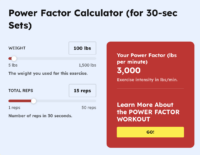
Then calculate your output. If you press 135 pounds for 20 reps in 30 seconds, that is 2,700 pounds moved in half a minute. Multiply by two and your Power Factor is 5,400 pounds per minute.
Now you have something most lifters never have: a number.
Next time, the goal is simple. Improve the number. Add weight. Add a rep. Improve the output. But only return when you are recovered enough to beat your previous performance.
Practical Tips for Men Over 40
Warm up thoroughly before heavy pressing. Shoulders, elbows, wrists, and upper back all need preparation.
Use a power rack every time. The pins are not decoration. They are what allow you to train hard without turning a missed rep into a dangerous situation.
Keep the movement short and identical from rep to rep. If the range changes every workout, your numbers lose meaning.
Do not train through pain. Pain is information. Adjust the pin height, reduce the load, or choose a different exercise if needed.
Finally, respect recovery. If your next shoulder press workout does not improve, the answer may not be less weight. The answer may be more rest.
The Bottom Line
The standing barbell shoulder press is one of the great upper-body strength builders. But after 40, it should be trained with intelligence, not nostalgia.
Use the strongest and safest range. Use a power rack. Measure your 30-second output. Record the result. Recover until you can improve it.
That is how you build powerful shoulders without turning your joints into the limiting factor.
If you want to apply this same measured, efficient approach to the rest of your training, learn more about the POWER FACTOR WORKOUT and how it helps men over 40 build new muscle with less wasted motion, less wasted time, and less unnecessary wear.