Most men do not wake up one morning and suddenly feel old.
It happens more quietly than that.
The luggage feels heavier. The stairs feel steeper. The belly grows while the shoulders shrink. A job in the yard that used to take an hour now takes a weekend. And somewhere along the line, the man who used to feel capable starts negotiating with weakness.
That is why building muscle after 40 is not just about looking better in a shirt.
It is about staying in command of your body.
Muscle Is Not Decoration
Muscle is useful tissue. It helps you stand, lift, brace, walk, climb, carry, push, pull, and recover from the physical demands of life. Strong legs and hips help you get out of chairs, climb stairs, and move with confidence. A strong back and trunk help protect posture and support real-world lifting. Strong shoulders, chest, and arms help you press, carry, and control objects in daily life.
That matters more every year after 40.
When men lose muscle, they do not merely lose size. They lose options. They lose balance, power, athleticism, confidence, and the ability to do ordinary things easily. That is why muscle loss should not be treated as a normal inconvenience of aging. It should be treated as a problem worth fighting.
The Medical and Lifestyle Benefits of Keeping Muscle
Strength training is one of the most practical tools older men have for staying functional. Proper resistance training can support bone strength, help preserve lean mass, improve physical function, reduce the risk of falls, and make daily activities easier to perform.
That is the obvious side.
There is also the less visible side. Muscle is metabolically active tissue. When you train it, challenge it, and preserve it, you are also supporting the machinery that helps your body handle energy, glucose, fat, and recovery. The point is not that muscle makes you immortal. It does not. The point is that a stronger body usually gives a man more margin.
More margin when he slips.
More margin when he has to carry something heavy.
More margin when life demands effort.
And that margin is valuable.
Why Older Men Need a Smarter Method
Here is where many men make the wrong turn.
They know they need muscle, so they go back to the gym and train the way they did at 25. More sets. More days. More soreness. More volume. More punishment.
Then the joints complain. Recovery slows. Progress stalls. Enthusiasm fades.
The conclusion they reach is, “I guess I’m too old for this.”
Wrong conclusion.
The better conclusion is, “I need to train with more intelligence.”
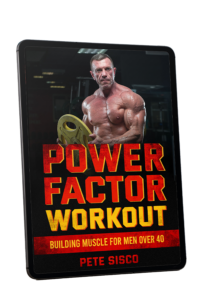
The Power Factor Workout is built on that exact idea. Do not just exercise. Measure. Do not just get tired. Improve. Do not just add volume. Add productive intensity. Do not grind through painful ranges because gym tradition says so. Use your strongest and safest range, where the muscles can be loaded heavily and the joints are not being asked to pay the price for wasted motion.
The Muscles That Matter Most
If you want to retain strength as you age, focus on the big muscle groups that change how your whole body performs.
Train the legs and hips because they are the foundation of movement. Train the back because posture, pulling strength, and spinal support matter. Train the chest, shoulders, and triceps because pressing strength is useful in and out of the gym. Train the arms and grip because weakness often shows up first in the hands. Train the trunk because a strong body needs a strong brace.
But do not confuse “train everything” with “do everything.”
A smart workout selects the exercises that produce the highest useful muscular demand with the least wasted effort. That is especially important for men over 40, because every workout has a cost: time, recovery, wear, and motivation.
Practical Rules for Building Muscle After 40
First, record your workouts. Write down the weight, reps, and time. Your memory is not a training system.
Second, use a safe setup. Power racks, Smith machines, properly adjusted machines, and controlled ranges exist for a reason.
Third, train in your strongest and safest range when heavy loading is the goal. The weakest range of a lift should not be allowed to limit the productive work your stronger muscles can perform.
Fourth, make every workout measurable. If your output is not rising over time, something is wrong. It may be the exercise, the load, the range, the recovery period, or the frequency.
Fifth, recover more than you think you need. Muscle is not built during the workout. The workout is the stimulus. Recovery is where adaptation earns its keep.
The Bottom Line
For men over 40, muscle is not vanity. It is protection. It is capability. It is independence. It is the difference between merely getting older and staying physically useful, strong, and confident as the years pass.
You do not need to live in the gym. You do not need to punish your joints. You do not need to chase soreness like it proves something.
You need productive effort. You need measurement. You need recovery. You need a system that respects the realities of an older body while still demanding progress from it.
That is what the Power Factor Workout was designed to do.
If you want to build muscle after 40 with less wasted time, less joint punishment, and more measurable progress, learn more about the Power Factor Workout and start training with numbers instead of guesswork.
Train with your brain.