Most men in the gym save their hardest rep for last.
They start with a weight they can handle for eight, ten, or twelve reps. The first few reps are easy. The middle reps are work. Then, finally, the last rep demands everything they have.
Here is the obvious question: if the last rep is the one that really challenges the muscle, why spend most of the set getting there?
That is the logic behind “Do Your Last Rep First.” It is not a slogan. It is a more intelligent way to think about muscle-building exercise, especially for men over 40 who want more muscle, more strength, less joint pain, and fewer wasted workouts.
The Problem With Saving the Hard Work for Last
Traditional full-range lifting often forces you to choose a weight you can move through the weakest part of the exercise. On the bench press or chest press, that weak position is usually the bottom range, where the shoulders are stretched, the elbows are deeply bent, and old aches often make themselves known.
So what happens?
You reduce the weight so you can survive the weak range. But now your strongest range is underloaded. Your chest, triceps, and front deltoids may be capable of handling far more productive resistance, but they never receive it because the weakest part of the lift dictates the weight.
For a 25-year-old, that may be merely inefficient. For a man over 40, 50, or 60, it can be inefficient and irritating. Your joints have a longer history. Your recovery is not unlimited. Your time matters. So your workout must earn its place in your life.
Use the Strongest and Safest Range
In the Power Factor Workout, the goal is not to make an exercise look impressive to the guy across the gym. The goal is to make the exercise objectively productive.
For a chest press, that means using a controlled, shortened range where your chest, triceps, and shoulders can produce high muscular output without forcing you into the vulnerable bottom position. A Smith machine, power rack, or well-controlled chest press machine can help you set this up safely.
This does not mean bouncing, jerking, ego-lifting, or performing sloppy half-reps. It means deliberately working in the range where you can apply more productive resistance to the target muscles while reducing wasted movement.
In plain English: you make the set hard from the beginning instead of waiting until the end.
Why This Matters for Chest, Triceps, and Shoulders
The chest press is one of the most valuable upper-body exercises because it trains several important muscles at once. The pectorals provide pushing power. The triceps extend the elbows. The front deltoids help drive the movement. Supporting muscles around the shoulder girdle help stabilize the effort.
Strengthening these muscles is not just about looking better in a shirt, though that is a fine benefit. Stronger pressing muscles help with real-life tasks: pushing yourself up from a chair, moving heavy objects, carrying luggage, working around the house, and maintaining the upper-body strength that too many men gradually surrender with age.
For men over 40 lifting weights, this kind of practical strength matters. Muscle is not decoration. It is protection, capability, and independence.
How to Try “Do Your Last Rep First”
Warm up thoroughly first. Then choose a chest press variation you can control safely. Set the movement so you are working only in your strongest, pain-free range. Use a weight that is heavier than your normal full-range working weight, but still completely under control.
Now perform as many smooth, strong reps as you can in exactly 30 seconds.
Record three things:
- The weight used
- The number of reps completed
- The exact time of the set
That gives you something most lifters never have: a measurable result. Next time, your job is not to “feel the burn” or wander around looking for a new routine. Your job is to beat that number by adding a little weight, adding a rep or two, or improving your total output in the same 30 seconds.
Do Not Confuse More Work With Better Work
Many older lifters are not failing because they lack discipline. They are failing because they are spending too much recovery capacity on low-value work.
More sets do not automatically mean more muscle. More soreness does not automatically mean more progress. More days in the gym do not automatically mean better results.
After 40, the smarter question is this: “Did today’s workout produce enough measurable intensity to justify the recovery cost?”
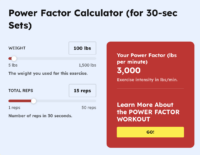
That is why the Power Factor approach is so useful. It gives you numbers. It lets you compare workouts. It shows whether you are progressing, stalled, or training too often.
The Takeaway
“Do Your Last Rep First” means stop wasting the first half of a set on easy reps that do little more than consume time and recovery. Use your strongest and safest range. Challenge the target muscles with meaningful resistance. Track the result. Then recover long enough to beat it next time.
That is how men over 40 can keep building muscle without turning the gym into a joint-grinding punishment chamber.
If you want a complete system built around measurable intensity, progressive overload, and smarter recovery, learn more about the POWER FACTOR WORKOUT.
Train with your brain, and let your numbers tell you the truth.