There is a saying attributed to Bruce Lee and his practical approach to training: “Everything works and nothing works.”
It is a wonderfully useful idea because it punctures the biggest lie in the gym: that there is some special routine, one critical exercise, one magic rep range, or one perfect schedule that works forever for everyone.
The truth is more practical. Almost anything can work for a while if it asks your muscles to do something they are not used to doing.
High reps can work. Low reps can work. Machines can work. Free weights can work. Full range training can work. Partial-range training can work. Even a bad program can work briefly if it happens to create a new demand.
But here is the part most lifters miss: a method “working” once is not the same as a method producing reliable progress month after month.
I know for a fact that some people have looked at my training and quickly concluded, “Oh, it’s all about partial reps. I’ll try it!” Pretty soon they burn out and declare, “It doesn’t work!” Or, more charitably, “It didn’t work for me.”
Then they go back to some other “system.”
The Problem Is Not Effort. The Problem Is Unmeasured Effort.
Walk into any gym and you will see plenty of effort. Guys are sweating, straining, loading plates, changing exercises, and trying hard. I respect that. Nobody stays in the gym after 40 unless he has some level of discipline.
But discipline without measurement can become a trap.
If you do not know your actual output, you do not know whether your workout was productive or merely exhausting. You may know that your chest burned. You may know that your joints complained. You may know that you were sore for three days. But none of that proves you generated more muscle-building intensity than last time.
A muscle doesn’t grow because you entertained . It doesn’t grow because you confused it. Or because you punished yourself. Muscle grows because your body is forced to adapt to a higher level of demand.
That demand must be progressive from workout to workout. And progressive means measurable.
Why “Everything Works” Can Become a Dangerous Idea
There is a seductive comfort in believing every training method works. It lets a guy drift from one routine to another without ever facing the numbers.
This month it is high-volume bodybuilding. Next month it is a five-day split. Then it is slow reps. Then supersets. Then a new machine. Then an old-school barbell routine. Every change feels like progress because it feels different.
But different is not the same as better.
If you are not tracking weight, reps, time, and recovery, you are training blind. You cannot know whether the new routine created more objective intensity. You cannot know whether you recovered enough before repeating the workout. You cannot know whether you are stronger or just more tired.
That is why “everything works” must be balanced by “nothing works forever unless you can prove it is still working.”
The Power Factor Difference: Measure the Work
The Power Factor Workout is built around a simple idea: stop guessing.
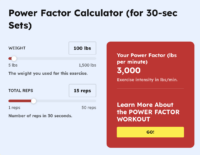
Instead of judging a workout by sweat, soreness, pump, or gym time, judge it by output. For a timed set, record the weight and the number of reps completed in a fixed period. In a 30-second set, you can calculate your Power Factor number by multiplying weight by reps, then multiplying by two to express the result in pounds per minute.
For example, if you lift 200 pounds for 15 reps in 30 seconds, that is 3,000 pounds in half a minute, or 6,000 pounds per minute.
Now you have something useful. You have a number.
Next workout, the question is not, “Did I feel motivated?” The question is, “Did I improve that number?”
That one question changes everything.
Progressive Overload Needs a Scoreboard
Everyone talks about progressive overload. Fewer people actually track it.
Progressive overload does not mean adding random exercises. It does not mean doing more sets until your elbows ache. It does not mean training more often because you are impatient.
Progressive overload means your muscles are being asked to do more than before in a way that can be observed and compared.
That could mean more weight. It could mean more reps with the same weight in the same time. It could mean a higher Power Factor number on the same exercise. But unless you write it down, you are trusting memory, mood, and gym folklore.
Your logbook should become your training scoreboard. It tells you what to beat. It tells you when you are improving. It also tells you when you are not recovering.
Recovery Is Not Laziness. Recovery Is Part of the System.
This is especially important for men over 40.
A younger man can sometimes get away with poor programming because his recovery capacity is more forgiving. That does not mean he is training intelligently. It only means youth is covering the bill for a while.
After 40, 50, or 60, the bill comes due faster.
If your numbers are not increasing, one of the first questions should be: “Did I train again too soon?”
Most lifters assume a stalled workout means they need more work. Often, they need more recovery. Your body must first recover from the last demand before it can overcompensate and come back stronger.
If you return to the gym before that happens, you are not building momentum. You are interrupting the process.
The Bottom Line
Everything works and nothing works.
That is not a contradiction. It is a warning.
Everything can work under the right circumstances. Nothing keeps working if you stop adapting, stop recovering, and stop measuring.
For men over 40 who lift weights to build muscle, avoid joint pain, and prevent over-training, the answer is not more confusion. It is more clarity.
Measure your intensity. Track your progress. Give your body enough recovery to actually grow. Then return to the gym with one clear mission: beat your last number.
That is how training becomes intelligent. That is how progress becomes visible. And that is why the Power Factor Workout is not just another routine. It is a way to stop guessing and start training with your brain.
Ready to learn more? Read more about the POWER FACTOR WORKOUT and see how measured intensity, progressive overload, and smarter recovery can help you build new muscle after 40 without wasting time or beating up your joints.