Most men over 40 do not need a more complicated workout.
They do not need twelve new exercises, a celebrity routine, a “muscle confusion” plan, or another lecture about discipline. If they are already going to the gym and lifting weights, they probably have plenty of discipline.
What they need is a better return on the effort they are already making.
That is especially true when it comes to leg training.
Leg training matters. Strong legs affect nearly everything you care about as you get older: walking, climbing stairs, balance, athletic ability, confidence, metabolism, and the simple feeling that your body still belongs to you. But leg training is also where many older lifters run into trouble.
The knees complain. The hips object. The lower back joins the argument. And before long, a man who wants to build muscle after 40 starts quietly negotiating with his own body.
“I’ll go lighter today.”
“I’ll skip legs this week.”
“I’ll just do more reps.”
“I guess I’m getting old.”
No. That is not the right conclusion.
The right conclusion is that you may need to train your legs with more logic and less punishment.
Why the Leg Press Belongs in a Smart Muscle-Building Plan After 40
The leg press is one of the most useful exercises in the gym for men over 40 because it allows serious muscular overload without requiring you to balance a barbell across your back.
That matters.
A squat can be a fine exercise for some people. But if your goal is to safely generate high muscular output, the leg press gives you a very practical advantage: you can focus on driving with the target muscles instead of spending half your effort protecting your spine, stabilizing the bar, or worrying about losing your groove.
But here is where most people still get it wrong.
They assume the benefit of the leg press comes from moving the sled as far as possible.
That is not the Power Factor way to look at it.
The better question is not, “How far did the weight travel?”
The better question is, “How much productive muscular intensity did you generate?”
Those are not the same question.
Use Your Strongest and Safest Range
In the Power Factor Workout, one of the central ideas is to train in your strongest and safest range of motion.
On the leg press, that usually means working near the top portion of the movement, where your leverage is strongest and your knees and hips are not forced into the most vulnerable deep position.
This does not mean bouncing the sled. It does not mean locking your knees. It does not mean ego lifting.
It means warming up carefully, setting the machine properly, controlling the sled, and performing a short, powerful, repeatable movement of only a few inches in the strongest range you can safely handle.
Why do this?
Because the weakest portion of a lift often forces you to use a weight that is too light to seriously challenge your stronger range. If your joints complain at the bottom of a deep leg press, why build your entire muscle-building strategy around that painful position?
You are not in the gym to prove you can tolerate joint irritation.
You are there to stimulate new muscle and strength.
When you reduce the range to the strongest and safest portion of the exercise, you can often use substantially more weight. That heavier load can create a much higher level of muscular demand — and demand is what your body must adapt to.
Measure the Set for 30 Seconds
Here is where the Power Factor Workout separates itself from ordinary gym lore.
Do not just “do a hard set.”
Measure it.
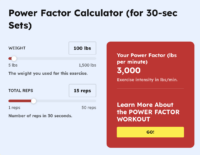
After your warm-ups, choose a serious but manageable weight and perform as many controlled reps as you can in exactly 30 seconds. Not 20 seconds. Not “about half a minute.” Exactly 30 seconds.
Then write down two numbers:
The weight you used.
The number of reps you completed.
That gives you something most lifters never have: objective evidence.
If you leg press 600 pounds for 20 reps in 30 seconds, that is 12,000 pounds moved in 30 seconds. Multiply by two and you get a Power Factor of 24,000 pounds per minute.
Now you have a number to beat.
That changes everything.
Your next workout is no longer vague. You are not wandering into the gym hoping to feel motivated. You have a target. Add a little weight. Add a rep or two. Improve the number.
That is progressive overload with a scoreboard.
Stop Repeating the Same Workout
One of the biggest reasons older lifters stall is that they keep repeating the same workout while hoping for a different body.
Same weight.
Same reps.
Same schedule.
Same fatigue.
Same result.
Your body adapts only when it has a reason to adapt. If your leg press output is not increasing over time, your legs have no measurable reason to become stronger.
This does not mean you need endless variety. In fact, random variety can make progress harder to measure.
Keep the exercise consistent. Keep the time period consistent. Keep the range consistent. Then improve the output.
That is how you turn a simple leg press into a precise muscle-building tool.
Recovery Is Part of the Workout
Here is the part many men over 40 resist.
If your numbers do not improve, you may not need more work. You may need more recovery.
A productive leg press session can place a serious demand on the body. That is the point. But the workout is only the stimulus. The improvement happens after the workout, when your body recovers and overcompensates.
If you train again before that process is complete, you can sabotage the very progress you are trying to create.
So judge your schedule by performance. If your numbers are going up, your recovery is probably working. If your numbers are flat or declining, do not automatically add more sets. First ask whether you came back too soon.
For many men over 40, less frequent training is not laziness.
It is strategy.
Practical Leg Press Checklist
Before trying this, warm up thoroughly and consult your physician before beginning any new exercise program. Stop immediately if you feel pain, strain, dizziness, or anything unusual.
On your next leg press workout, use this simple checklist:
- Choose a safe leg press machine.
- Warm up gradually.
- Set the sled so you can work in your strongest pain-free range.
- Do not lock your knees.
- Move the sled only a few controlled inches.
- Use a weight that challenges you for 30 seconds.
- Record weight and reps.
- Try to beat that output next time.
- Do not return to leg training until you are ready to improve.
That is simple. But simple is not the same as easy.
Done correctly, this kind of training demands focus, effort, and honesty. It also removes a great deal of wasted motion.
The Bottom Line
If you are a man over 40 trying to build muscle, avoid joint pain, and stop over-training, the answer is not always more exercise.
Often the answer is better exercise.
The leg press, performed in your strongest and safest range, measured for 30 seconds, and improved only when recovery allows, can become one of the most productive tools in your entire muscle-building program.
Train harder where it counts. Measure what matters. Recover like progress depends on it — because it does.
To learn how this same logic applies to the rest of your body, learn more about the Power Factor Workout and the 30-second method for building new muscle after 40.
Train with your brain,
Pete Sisco